

Clinically reviewed by Hemal V. Mehta, MD and Kate Sherman, PA-C, Vita Nova Stem Cell Professionals
Patients who arrive at Vita Nova having already done their homework usually ask the same question: PRP or stem cells, which one do I need? It is the right question. The answer depends on what is wrong, what has been tried, what your imaging shows, and what you want to be able to do six months from now. There is no universal answer. There is, however, a structured way to think about the choice, and that framework is what this article describes.
Both PRP and cell-based therapy fall under the umbrella of orthobiologics. Both use materials from your own body, both are minimally invasive, and because the material is your own, the risk of rejection is minimal. The differences are in mechanism, evidence base, complexity, and cost. Understanding those differences is what makes the conversation with a regenerative medicine physician productive rather than abstract.
What Each Therapy Actually Does
Platelet-Rich Plasma (PRP)
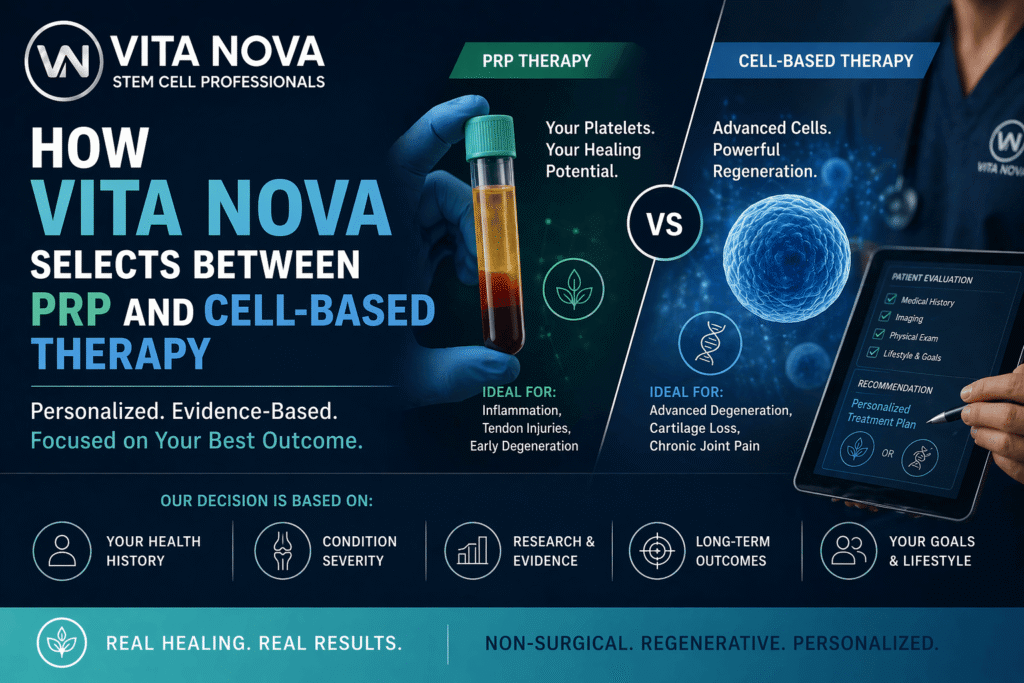
PRP therapy is prepared from your own blood. A small sample is drawn, processed in a centrifuge to concentrate the platelets, then injected into the affected tissue under image guidance. Platelets carry growth factors that signal repair and modulate inflammation. PRP does not introduce new cells. It amplifies the signaling that tells the cells already in your tissue to do their job better.
Cell-Based Therapy
Cell-based therapy is structurally different. Cells are harvested from your own bone marrow or adipose (fat) tissue, processed on-site, and reintroduced into the affected area. The cells themselves are part of what is delivered. The biological mechanism is more complex: in addition to signaling effects similar to PRP, current research suggests these cells work largely by releasing signals that modulate inflammation and support repair in the joint environment.
How the Evidence Compares
This is where honest framing matters. The evidence bases for PRP and cell-based therapy are at different stages of maturity, and patients deserve to know that.
PRP has a longer and more mature evidence base than cell-based therapy. Two decades of trials, dozens of randomized studies, and multiple high-quality meta-analyses have shaped how clinicians interpret PRP outcomes. Among the most recent large-scale evidence in knee osteoarthritis is a 2025 meta-analysis in the American Journal of Sports Medicine, which found that improvement after PRP is clinically significant and influenced by platelet concentration. For tendon conditions, the evidence base is similarly substantial, with multiple meta-analyses supporting PRP for chronic tendinopathy and partial tears. PRP is not FDA-approved for orthopedic indications.
Cell-based therapy evidence is newer and at a different maturity level. Current systematic reviews, including a 2024 analysis in Osteoarthritis and Cartilage, show favorable outcomes for mesenchymal stem cell therapy in knee osteoarthritis, but grade the certainty of that evidence as low to moderate. The direction of benefit appears consistent across studies. The magnitude and durability of that benefit are less certain than for older interventions.
Professional society guidance reflects this difference in evidence maturity. Some guidelines, including the 2019 American College of Rheumatology and Arthritis Foundation guideline for hand, hip, and knee osteoarthritis, currently recommend against routine use of PRP and cell-based injections, citing insufficient evidence. More recent meta-analyses, including 2025 data on high-platelet PRP, have begun to shift this conversation, but professional society guidance has not yet caught up.
How We Think About Patient Selection
Selection between PRP and cell-based therapy at Vita Nova starts with three questions: what is the underlying condition, what is the extent of tissue damage on imaging, and what has the patient already tried.
Condition Type
PRP tends to perform best where the tissue is structurally intact but functioning poorly. Tendinopathy is the clearest example. The tendon is there, the structure is preserved, but the cellular signaling that maintains tissue health has gone wrong. PRP delivers a concentrated dose of the right signals.
Cell-based therapy comes into the conversation when the tissue itself is the problem. Cartilage loss in moderate osteoarthritis, post-meniscectomy joint changes, and chronic conditions where the underlying tissue has begun to fail are situations where the additional biological complexity of cell-based therapy may matter clinically.
Extent of Damage on Imaging
Imaging tells us how much tissue is left to work with. For knee osteoarthritis, the Kellgren-Lawrence grading scale (grade 0, no osteoarthritis, through grade IV) gives a structured way to assess this. Grades I and II are typically PRP candidates. Grade III may be PRP, cell-based, or both depending on the patient. Grade IV (bone-on-bone) is generally beyond the reach of either therapy and warrants a surgical conversation.
Treatment History
What you have already tried matters. A patient who has had cortisone injections, completed physical therapy, and not improved is in a different position than a patient exploring options for the first time. PRP is often a reasonable next step for patients new to orthobiologics. A patient who has tried PRP without adequate response may be a better candidate for cell-based therapy.
When the Answer Is Both
Some clinical situations call for PRP and cell-based therapy used in combination or in sequence. The biological rationale is straightforward: PRP delivers growth factor signaling, cell-based therapy delivers cells. The two are not redundant. In selected cases, a combined or staged approach may produce complementary effects. This is a clinical decision based on the specific case rather than a default protocol.
When the Answer Is Neither
Equally important: there are patients for whom neither PRP nor cell-based therapy is the right answer. End-stage joint disease with severe deformity, complete rotator cuff tears requiring surgical reconstruction, acute fractures, and certain inflammatory conditions are situations where regenerative medicine is not the appropriate path. A responsible regenerative medicine physician will say so. A clinic that tells every patient they are a candidate is not giving individualized care.
The Cost and Time Difference
PRP is faster, less expensive, and less complex to deliver. The procedure is typically completed in a single office visit. Cell-based therapy involves cell harvest, processing, and image-guided administration, with corresponding differences in time and cost. Neither is covered by most insurance plans.
Cost is a real factor in patient decisions. We discuss it openly during consultation, including realistic expectations about what each therapy is likely to deliver for the cost involved. The right therapy at the wrong price for your situation is not the right therapy.
Why Provider Selection Matters
This is the part most patients underestimate. The choice between PRP and cell-based therapy matters less than the choice of provider performing the procedure. PRP done well outperforms cell-based therapy done poorly. Both therapies depend on preparation method, image guidance precision, anatomical knowledge, and patient selection judgment.
Reasonable questions to ask any regenerative medicine provider: How is the PRP or cell preparation processed and what concentration do you target? Is the lab work done in-house or sent out? Do you use ultrasound or fluoroscopic guidance for injection? How many of these procedures have you performed for my specific condition? What outcomes do patients with similar imaging report?
How Vita Nova Is Set Up
First, both PRP and cell preparation are processed in our on-site laboratory under direct clinical supervision rather than sent to an outside facility. This keeps quality control, processing standards, and turnaround time under direct physician oversight.
Second, every patient is evaluated by Dr. Hemal V. Mehta and Kate Sherman, PA-C together. Dr. Mehta brings 25 years of clinical practice in physical medicine and rehabilitation with fellowship training in interventional spine and pain medicine. Kate brings over 20 years of clinical experience with deep orthopedic focus. Two clinicians with overlapping but distinct expertise looking at the same case produce a more complete assessment than either could alone.
Third, the consultation is structured around honest answers. Some patients leave with a recommendation for PRP. Some leave with a recommendation for cell-based therapy. Some leave with a recommendation to pursue surgical evaluation first. Some leave with a recommendation to start with physical therapy before considering regenerative care. The point of the consultation is to give you a real answer.
Schedule Your Evaluation
If you would like a physician-level evaluation to help decide between PRP and cell-based therapy for your case, Vita Nova Stem Cell Professionals in Franklin offers comprehensive consultations with no obligation to proceed.
Vita Nova Stem Cell Professionals
Phone: (615) 801-8005 | Email: info@vitanovatn.com
Phone Hours: Monday–Friday, 8 AM to 5 PM
Website: vitanovatn.com
Disclaimer: This article is for informational purposes only and does not constitute medical advice. Cell-based therapies for orthopedic conditions are not FDA-approved. PRP is similarly not FDA-approved for orthopedic indications. Individual results vary. Consult a qualified physician before making decisions about care.
Sources
- Bensa A, Previtali D, Sangiorgio A, Boffa A, Salerno M, Filardo G. PRP Injections for the Treatment of Knee Osteoarthritis: The Improvement Is Clinically Significant and Influenced by Platelet Concentration: A Meta-analysis of Randomized Controlled Trials. American Journal of Sports Medicine. 2025;53(3):745-754.
- Sadeghirad B, Rehman Y, Khosravirad A, et al. Mesenchymal stem cells for chronic knee pain secondary to osteoarthritis: A systematic review and meta-analysis of randomized trials. Osteoarthritis and Cartilage. 2024;32(10):1207-1219.
- Tian X, Qu Z, Cao Y, Zhang B. Relative efficacy and safety of mesenchymal stem cells for osteoarthritis: a systematic review and meta-analysis of randomized controlled trials. Frontiers in Endocrinology. 2024;15:1366297.
- Oeding JF, Varady NH, Fearington FW, et al. Platelet-Rich Plasma Versus Alternative Injections for Osteoarthritis of the Knee: A Systematic Review and Statistical Fragility Index-Based Meta-analysis of Randomized Controlled Trials. American Journal of Sports Medicine. 2024;52(12):3147-3160.
- Kolasinski SL, Neogi T, Hochberg MC, et al. 2019 American College of Rheumatology/Arthritis Foundation Guideline for the Management of Osteoarthritis of the Hand, Hip, and Knee. Arthritis & Rheumatology. 2020;72(2):220-233.
- U.S. Food and Drug Administration. FDA regulation of human cells, tissues, and cellular and tissue-based products (HCT/Ps). 21 CFR Part 1271.